

Overview
Vacuum system:
Beam stability and beam lifetime are the major requirements for good operation of the synchrotron light sources. Pressures in the range of low 10-9 mbar are typical values to be achieved during operation in order to have a good beam lifetime; the pressure inside the vacuum chamber is produced by the thermal desorption and the photon stimulated desorption processes, the interaction between the electron beam with the residual gases leads to an elastic and inelastic scattering causing electron losses and reducing the lifetime of the beam.
The main role of the vacuum system is to maintain vacuum chamber, in which the beam circulates, under very low gas pressure (called Ultra-High Vacuum (UHV)) to ensure beam stability and long lifetime. The vacuum system includes the vacuum chamber, vacuum pumps (that maintain the vacuum chamber under low gas pressure), vacuum gauges that monitor the pressure value in the vacuum chamber, in addition to the auxiliary tools and equipment. Hence to achieve the required values of the gas pressure, the following are needed:
- A well designed vacuum chambers
- Efficient pumping system,
- Monitoring the pressure along the ring,
- Good choice of vacuum chamber materials
- Efficient cleaning and conditioning for the vacuum chamber.
Front ends
A Front End (FE) is connected to the storage ring and passes through the shield wall where synchrotron light is delivered to the beamline.
The main functions of a front end are:
- To define the size of synchrotron light beam or photon beam (that is generated in the storage ring) delivered to the beamline.
- To monitor the position of the photon beam.
- To protect the storage ring if there is a vacuum leak in the beamline.
- To mitigate as much as possible, the heat load delivered by the synchrotron light to the optical components in the beamline.
- To allow safe access into the optical hutch when required while the machine in in operation.
Storage ring vacuum system:
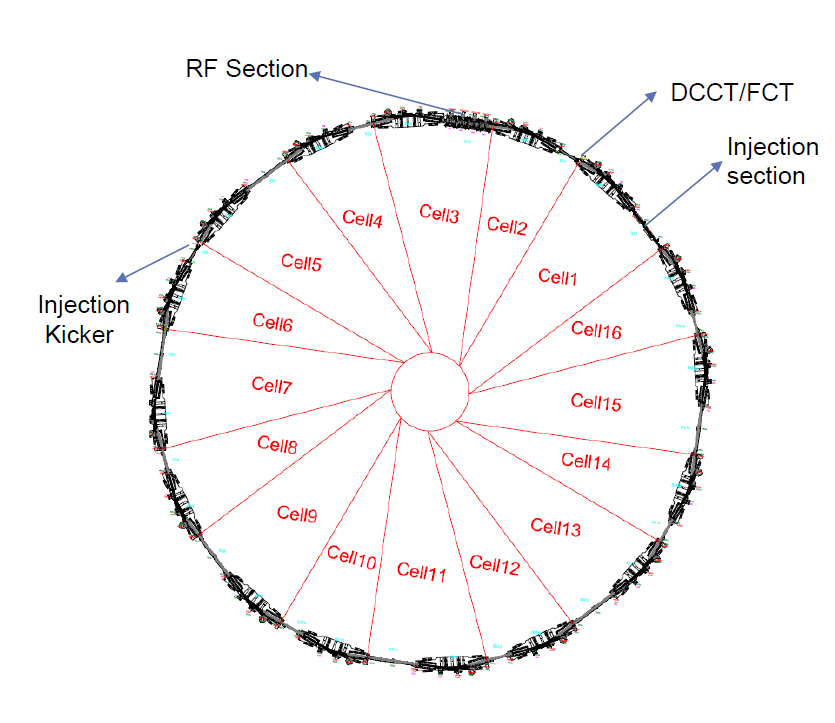
The storage ring is divided into 16 cells, each cell contains a dipole arc chamber and a straight chamber (long or short) closed by UHV RF shielded gate valve. There are two types of the vacuum cells, an arc chamber with long straight with a total length of 9.35m and an arc chamber with short straight with a total length of 7.3 m. Lumped absorbers are used to absorb the unwanted synchrotron radiation (SR), there are four types of the absorbers based on the location where they are installed.
Several sputter ion pumps (SIP) installed on the storage ring near the absorbers with an overall nominal pumping speed of 20500 l/s, also, a NEG pumps installed near the absorber with the highest SR absorbed (higher outgassing). Figure 1 shows the general storage ring vacuum layout.
Ion pumps | 105 Pumps |
|---|---|
Dipole Chamber | 2 X 300L/S |
2 X 150L/S | |
Long Straight | 3 X 150L/S |
Short Straight | 2 X 150L/S |
RF Section | 4 X 150L/S |
NEG pumps | 16 |
IMG | 27 |
Dipole Chamber | 16 |
Long Straight | 27 |
RF Section | 4 |
RF Values | 16 |
RF Bellows | 34 |
Front ends:
Starting from the storage ring side, the front end elements include:
- X-ray Beam Position Monitor (XBPM) that provides information regarding the position of the photon beam.
- Fixed Mask that cuts off that part of the photon beam that falls outside the BL’s angular acceptance. This element defines the maximum aperture available for the BL and reduces the heat load on all the FE elements installed downstream.
- Photon Shutter that is able to block the synchrotron radiation beam. The Fixed Mask and the Photon Shutter shall be mounted one next to the other on a common support, which will also provide pumping capacity for absorbing the radiation outgassing together with local vacuum readings.
- Fast Closing Shutter protecting the SR vacuum integrity from any accident occurring in the BL. The two trigger gauges controlling the actuation of this element will be installed in the BL side
- Movable Masks allowing BL users to define the photon beam dimensions within the aperture defined by the Fixed Mask. This unit shall also incorporate pumping capacity and vacuum readings.
- Bremsstrahlung Shutter that is able to block most of the high energy radiation (gas Bremsstrahlung radiation, secondary Bremsstrahlung radiation, etc.) directed towards the BL.
Mohamed AL NAJDAWI
Supervisor of Vacuum and Cooling Team
Email: mohammad.najdawi@sesame.org.jo
Work Tel: +962 5 351 1348 (Ext. 210)
Adel AMRO
Assistant Vacuum Engineer
Email: adel.amro@sesame.org.jo
Work Tel: +962 5 3511348 (Ext 232)
Mahmoud IRSHEID
Senior Vacuum Technician
Email: Mahmoud.Irsheid@sesame.org.jo
Work Tel: +962 5 351 1348 (Ext. 232)
Sa'ed BUDAIR
Administrative Assistant
Email: Saed.budair@sesame.org.jo
Work Tel: +962 5 3511348 (Ext 232)